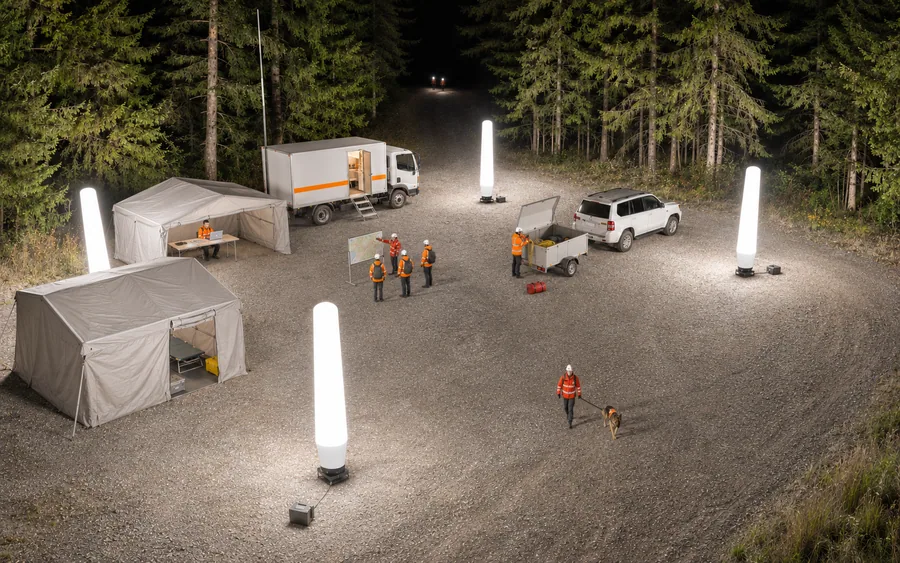
One tower on a forest track at night.

Inflatable LED light tower for night work

One person sets it up in 20 seconds.

Fits in a van, carried by hand

  1. 1Carry it in

    26 kg max. tower weight

  2. 2Plug it in

    230 V battery or generator

  3. 3Press AIR

    20 s to a standing column

AI-generated image: one worker lifts the packed tower out of a small service van. A portable generator stands on the ground beside the van. AI

How it goes up

  1. 1Press AIR

    The fan starts. The fabric fills while it lies on the ground.

  2. 2It stands up

    The column lifts in three seconds and is upright 20 seconds after AIR.

  3. 3Press LIGHT

    The LEDs in the base come on in two steps. No warm-up.

Why a glowing column

Floodlight on a mast

One bright point. Hard shadows, glare for drivers.

Glowing column

The whole column glows. Soft light on all sides.

The facts behind it

  • About half of the fatal crashes in US road work zones in 2023 happened at night.

    Source: US Federal Highway Administration

  • Outdoor work rules ask for 20 to 50 lux for general work and require glare and shadows to be limited.

    Source: HSE guidance HSG38, UK

  • A four-head trailer mast weighs about 1,050 kg. UK road guidance calls it a poor fit for short jobs.

    Source: Highways Agency, task lighting guidance, 2013

In a Purdue University study of road work lighting, floodlight masts needed more than 5.5 m of height to cut glare noticeably. Balloon lights needed more than 3 m.

Cement plants

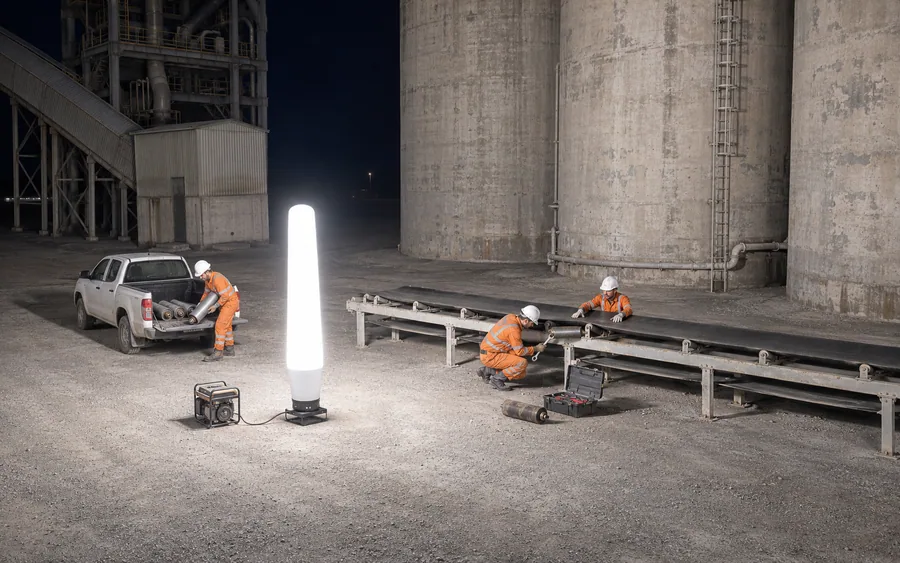
A night repair on the conveyor line

AI-generated image: A night repair on a belt conveyor in a cement plant yard. Three fitters, a pickup and silos behind, lit by one tower with a small generator. AI

Situation
A belt or a crusher stops at night, and the repair point lies outside the plant's fixed lighting.
Usual light
Hand lamps and vehicle headlamps light one side of the machine, and the crew works in its own shadow.
With a glowing column
One tower next to the machine lights the whole repair point, on all sides.
Evidence
EN 12464-2 gives light levels for outdoor work places in industry.

Mining and quarries

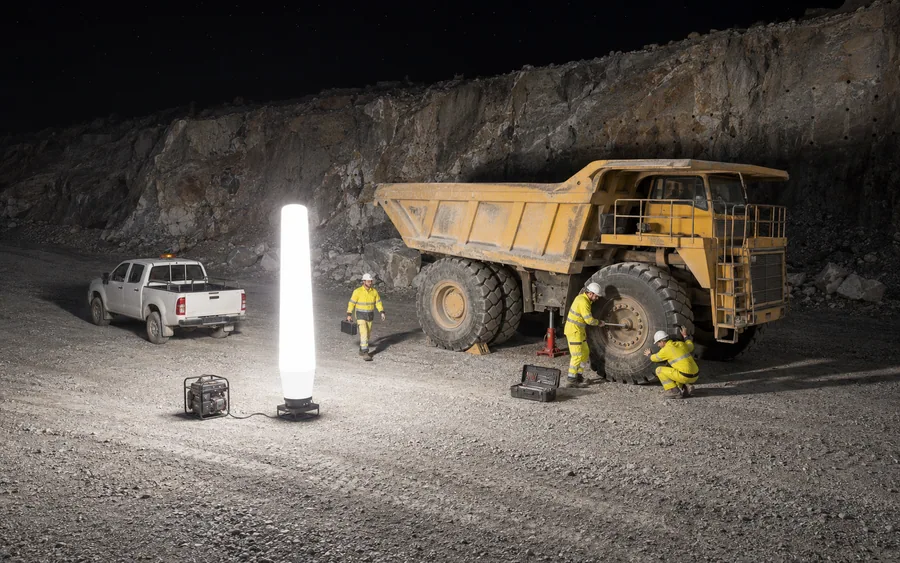
A machine stops in the pit at night

AI-generated image: A haul truck stopped on a quarry bench at night. Three mechanics at its front wheel and a pickup, lit by one tower with a small generator. AI

Situation
A haul truck or an excavator breaks down on a night shift, far from the fixed lighting.
Usual light
A trailer mast is slow to bring to a breakdown, and headlamps light one side only.
With a glowing column
A tower that comes in the service pickup and lights the machine from close by.
Evidence
US mine safety rules require light sufficient for safe work in the work areas of surface mines (30 CFR 56.17001).

Construction and temporary sites

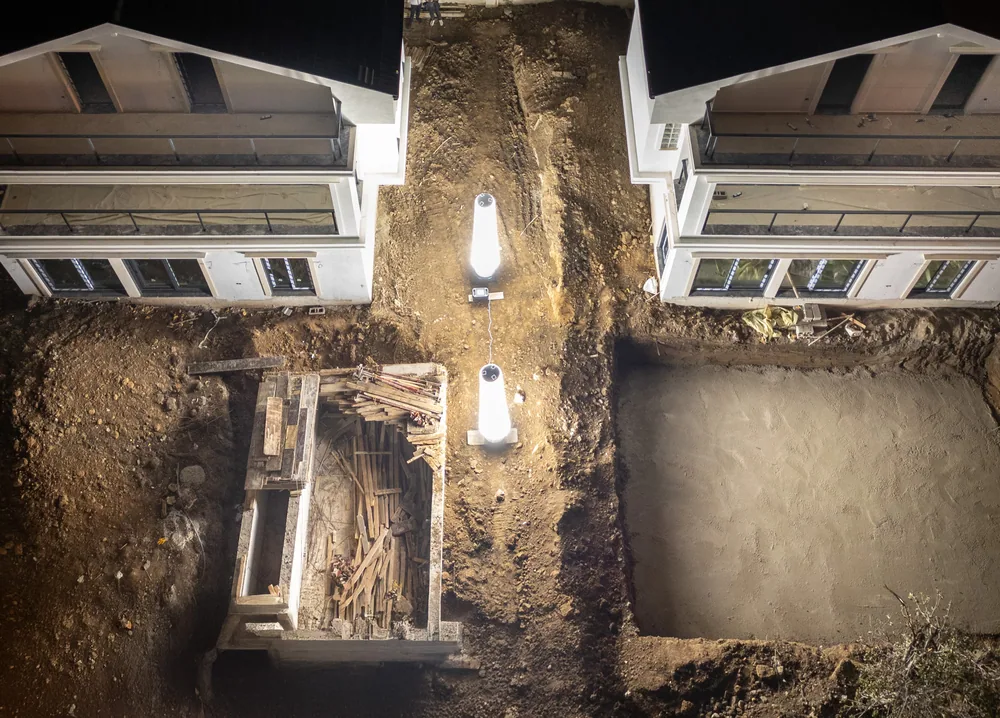
A building plot after dark

Two towers on a house plot, seen from a drone.

Situation
Earthworks, deliveries and inspections on a site with no fixed lighting.
Usual light
Site rules ask for about 20 lux to move around and 50 lux for general building work, with glare and shadows kept down.
With a glowing column
Two towers lit this house plot, façades included.
Evidence
EN 12464-2, HSE HSG38 and BG BAU give the same steps.

Rescue services

A field command post at night

AI-generated image: a rescue service's field command post at night. A command truck, two tents and a briefing at a map board, lit by four towers on the perimeter of the camp. AI

Situation
A search for a missing person runs through the night from a command post set up at the edge of the terrain.
Usual light
Vehicle lamps and head torches light one spot each. The map, the kit and the ground between the tents stay dark, and teams coming back look for the post in the dark.
With a glowing column
Four towers on the perimeter light the whole camp and mark it from a distance.
Evidence
Until 2018 the German federal relief agency THW ran 140 lighting units, with a balloon light as the standard alternative to a mast trailer.

Road works

Short night repairs next to live lanes

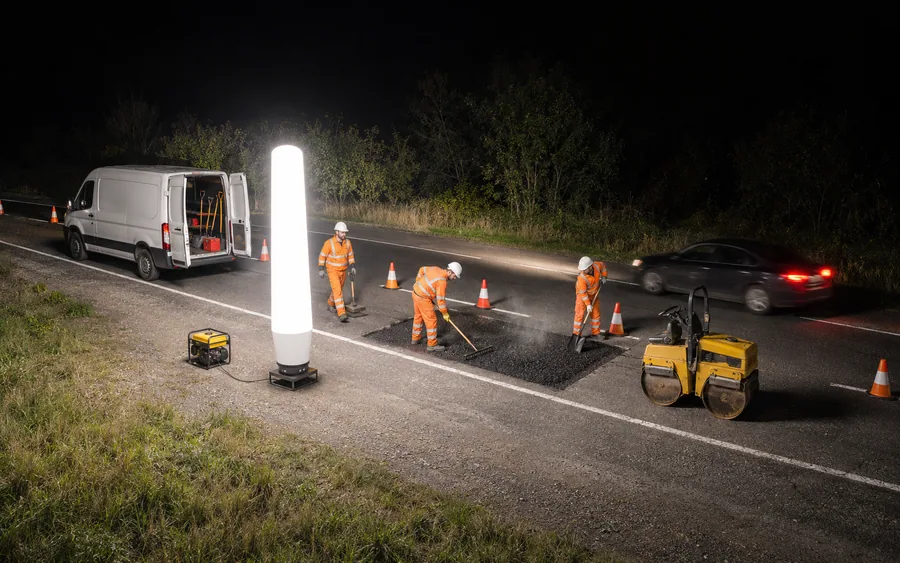
AI-generated image: A night patch repair in a closed lane. Three workers lay hot asphalt next to a van and a small roller; a row of cones separates them from the open lane, where a car passes. A lit tower with a generator stands on the verge. AI

Situation
Patching, joint repair, sign work. The crew has a few hours of lane closure.
Usual light
Floodlights and machine headlamps dazzle passing drivers and the crew. A trailer mast of about a tonne is awkward for a short job.
With a glowing column
A unit that travels in a van and stands up in seconds.
Evidence
The UK Highways Agency lists inflatable balloon lights as standard task lighting and notes that they reduce glare and shadow. Highways Agency task lighting guidance, 2013. The Illinois specification requires a balloon light on each moving machine during night paving (ATSSA night lighting guide).

Utilities

Emergency repair on a street

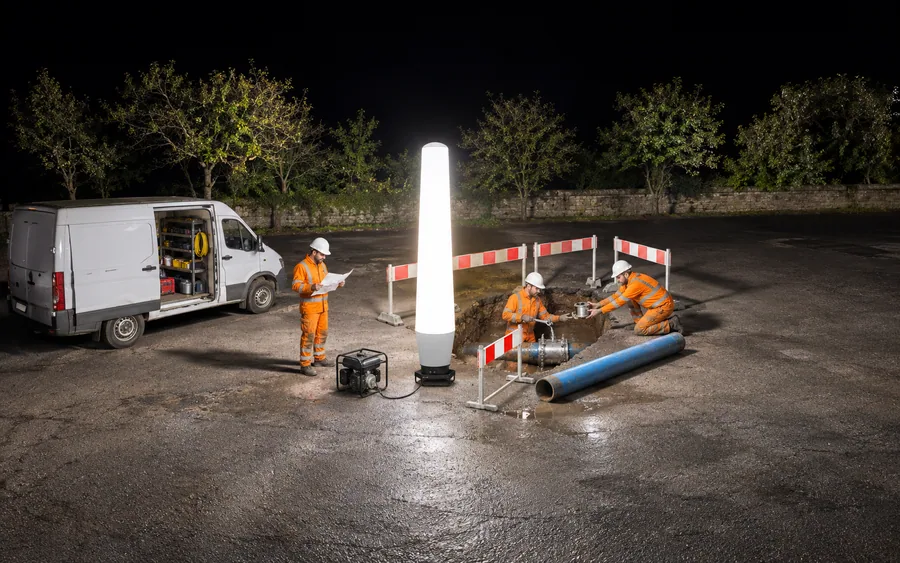
AI-generated image: A night street repair with a trench, barriers, a van, three workers, a generator and a lit tower. AI

Situation
A burst pipe or a cable fault at night. The crew opens the ground on a street where people live and traffic still passes.
Usual light
Bright work lights dazzle oncoming drivers and shine into the windows of the houses.
With a glowing column
Even light over the trench and the people around it.
Evidence
Utility Expo, overview of lighting gear for night utility work.

Rail

Night possession on the track

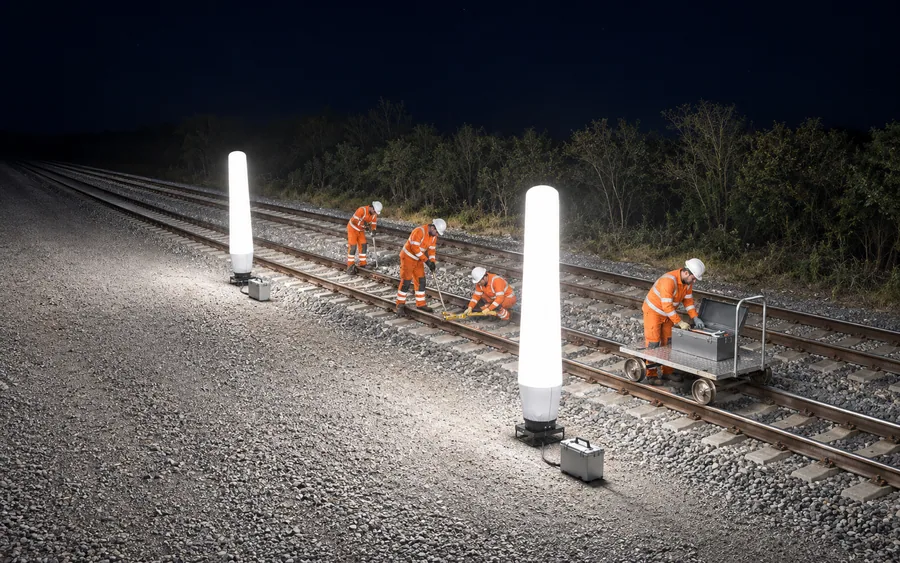
AI-generated image: Night work on a railway track. Three workers tighten and check the rail and a fourth takes a tool from a trolley. Two lit towers stand beside the track about 15 m apart, each with a battery pack. AI

Situation
Track work happens in night possessions, away from mains power.
Usual light
Generators bring noise, fumes and cables along the track.
With a glowing column
A light that one person carries to the work point and runs from a battery.
Evidence
A 2025 supplier catalogue for a French national railway framework contract includes balloon light kits with batteries.

Police

Collision investigation and checkpoints

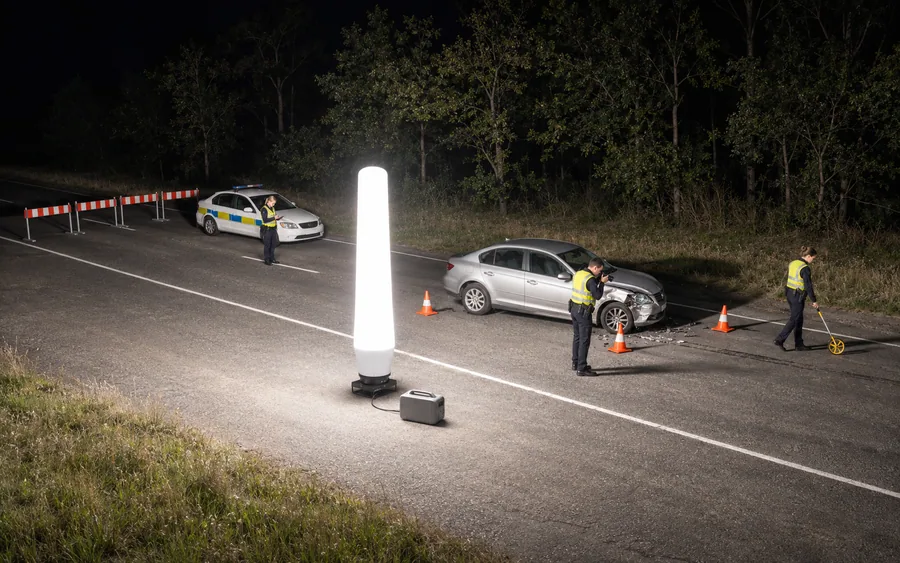
AI-generated image: A night road closed with barriers. Three police officers document a collision: one photographs a damaged car, one runs a measuring wheel along the tyre marks, one writes notes at a patrol car. A lit tower with a portable power station stands at the edge of the road. AI

Situation
Officers document a collision or run a roadside checkpoint in the dark.
Usual light
Flash distorts photographs. Several halogen stands mean cables across the scene and hot lamps.
With a glowing column
Diffuse light is easier to photograph in, and one unit replaces several stands.
Evidence
Police Magazine, guide to portable area lighting; Police1 report on responders switching to balloon lights.
Cutaway of the lower part of the tower. The base housing on its frame is cut open to show the fan and the LED light engine. The grey lower section and the white fabric column rise above them.

What is inside the base

  1. 1

    Fabric column

    Spreads the light on all sides.

  2. 2

    Bag and cuff

    The column packs into it.

  3. 3

    LED light engine

    Shines up into the column.

  4. 4

    Fan

    Keeps the column standing while the tower works.

  5. 5

    Air intake

    Under the housing.

  6. 6

    Housing and frame

    Polypropylene housing on a steel frame. Two buttons: AIR and LIGHT.

Runs from a generator or a battery

The tower draws 370 to 700 W. Any 230 V source from 1 kW runs it.

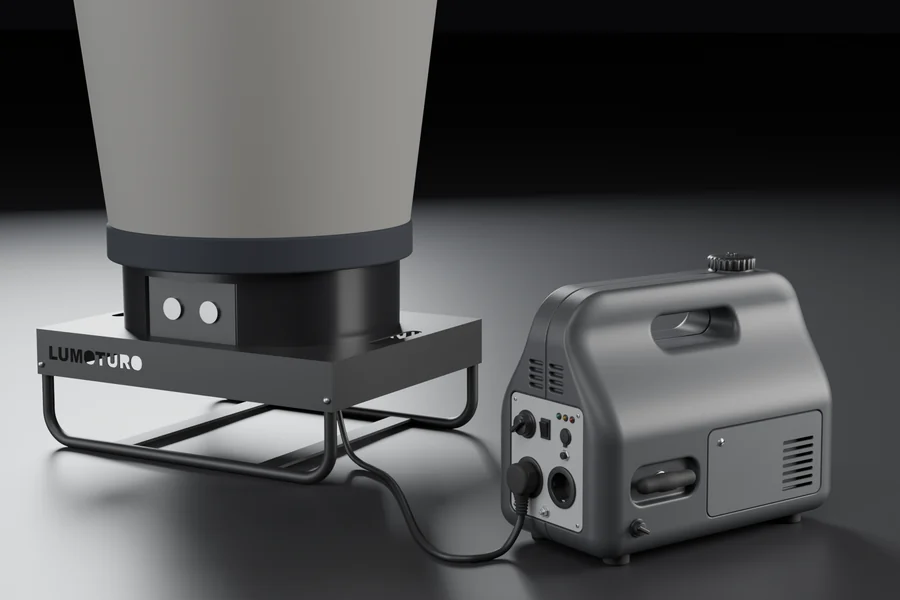
  • The base of the tower with a small petrol generator next to it, joined by a cable.

    Petrol generator

    Runtime
    4 to 7 hours on a 2-litre tank
    Weight
    about 13 kg
    What you need
    Inverter generator, 230 V, from 1 kW
    Fuel
    0.3 to 0.5 L of petrol an hour
    Best for
    Long shifts away from the grid
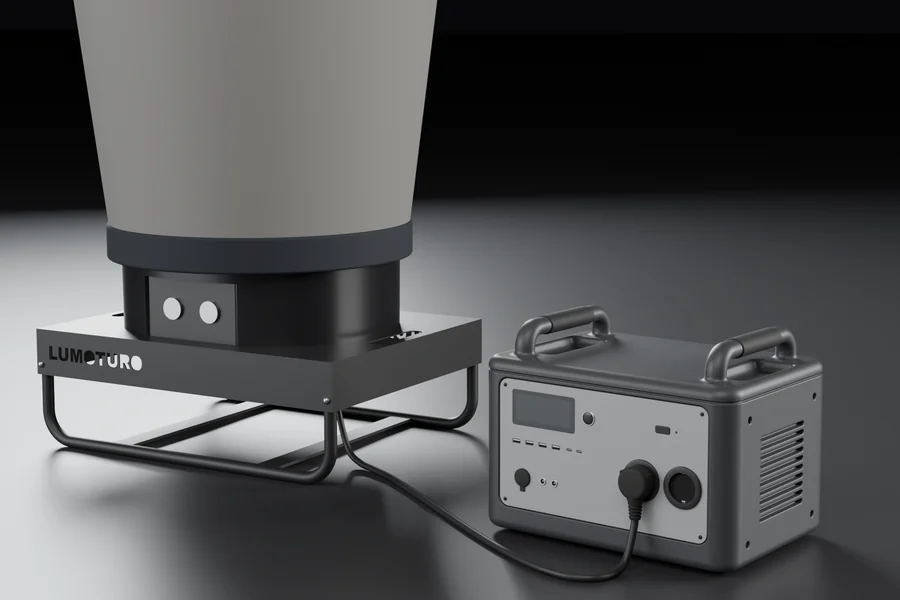
  • The base of the tower with a portable power station next to it, joined by a cable.

    Battery

    Runtime
    2.5 to 4.5 hours on 2 kWh1 to 2 hours on 1 kWh (about 11 kg)
    Weight
    about 23 kg for 2 kWh
    What you need
    Portable power station, 230 V output from 1 kW
    Recharging
    From any socket
    Best for
    Streets, rail and work next to people: no engine noise, no fumes

The power source is a separate item; we recommend one with the quote.

Runtime and fuel use are worked out for the tower's draw and for typical generators and power stations of these sizes.

Light coverage

Tower on. The pebble beach, the cliff and a person next to the tower are lit.
Tower off. The same beach at twilight. The tower and the person are dark silhouettes.
Tower off Tower on
Seen from straight above. A lit road incident with two cars and cones, the tower in the exact centre.
  • 15 mwork light, 20 lux at the edge
  • 24 mlight to move by, 5 lux at the edge

Reference light levels

  1. 5 lxPedestrian walkways
  2. 20 lxMoving people, machines and vehicles
  3. 50 lxGeneral construction work
  4. 100 to 200 lxWork with details

Reference levels from EN 12464-2, HSE HSG38 and BG BAU.

Specifications

  • 3.9 mheight
  • 20 sset-up, 1 person
  • 50,000 lmLED, 300 W
  • 15 mwork light across
  • 26 kgweight, up to
  • 25 m/swind, with guy lines
  • IP65/44protection
  • 24 monthswarranty

Dimension drawing of the tower Front view: 3.9 m tall overall, fabric column 3.5 m tall. Plan view: fabric 0.64 m across at the widest point, housing 474 by 414 mm. Front view 3.9 m 3.5 m Plan view 0.64 m 474 mm 414 mm
ItemValue
Height3.9 m
Fabric column3.5 m tall, 0.64 m at the widest point
Set-up1 person; 20 s from AIR to a standing column
Controlstwo buttons: AIR and LIGHT
Light sourceLED engine in the base, 50,000 lm, 300 W
Work light, 20 luxabout 15 m across
Light to move by, 5 luxabout 24 m across
Power supply220/230 V: mains, petrol generator or portable power station (not included)
Power drawlight 300 W; fan 400 to 600 W while the column lifts, 70 to 400 W in work
Weightup to 26 kg
Windup to 25 m/s with guy lines
Ingress protectionIP65/44
Operating temperature−30 to +40 °C
Housing474 × 414 × 145 mm, polypropylene
Frame600 × 450 × 200 mm, steel
Transport box68 × 52 × 58 cm
Design registrationDM/247268, Hague system; protected in the EU since 25 March 2025
CE markingyes
Warranty24 months
In the boxtower, three guy lines, manual, transport box

Coverage figures are for one tower on open, level ground.

Specifications may differ depending on the configuration.

Request a quote

We reply by e-mail with a price and a delivery time for your country.

What happens

  1. You send the use, the country and the number of towers.
  2. We reply with a price, a delivery time and the specification.
  3. We agree the power source and ship the tower to you.
  • CE marked
  • 24-month warranty

A quote request does not commit you to buy.

Questions

What does it run on?

Any 220/230 V source: the mains, a petrol generator or a battery (portable power station). The power source is a separate item; we recommend one with the quote.

How long does it run on a battery or a generator?

In work the tower draws 370 to 700 W. A 2 kWh portable power station runs it for 2.5 to 4.5 hours. A 1 kW petrol generator runs it for 4 to 7 hours on a 2-litre tank.

What about wind and weather?

With its three guy lines the tower stands in wind up to 25 m/s. Ingress protection is IP65/44, and it works from −30 to +40 °C.

Is it CE marked?

Yes. The tower carries the CE marking.

What is the warranty?

24 months.

What does it cost?

We quote for your country and quantity. Send the request and we reply with a price and a delivery time.

Get a price and a delivery time for your country.

Request a quote